
Tenant Remediation Guide
The deliverable your client actually keeps.
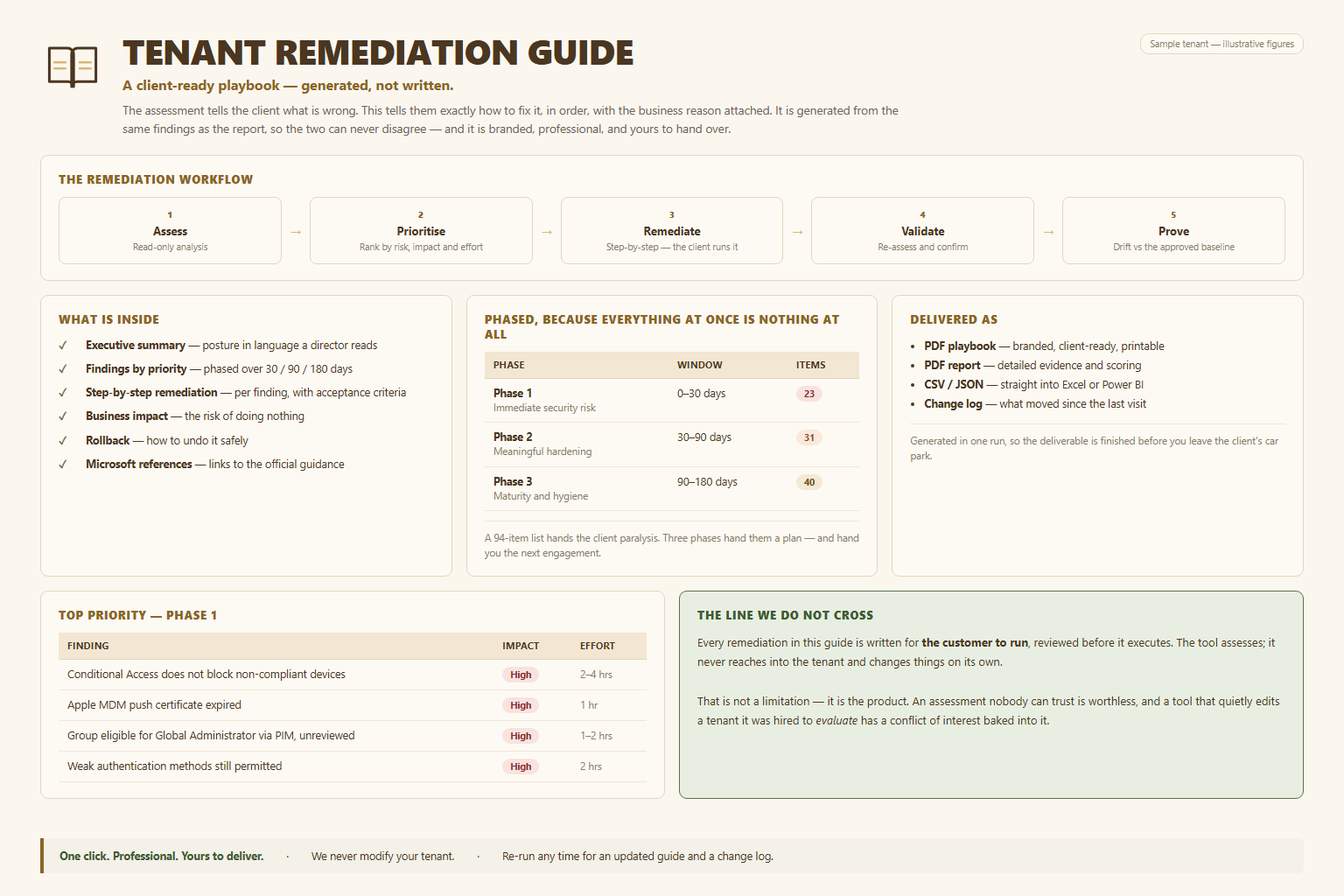
A client-ready playbook — generated from the assessment, not written by hand at eleven at night.
Why it matters
Competent work is invisible until it stops
Nobody thanks you for the outage that didn’t happen. When everything runs, there is nothing to point at — which is exactly why IT gets treated as an expense right up until the moment the ceiling falls in.
This document is the fix for that. It turns an afternoon of invisible work into something a client can hold: here is what we checked, here is what we found, here is what we did, here is what is left and when we will do it.
Not a dashboard they will never log into. A document that survives being forwarded to someone who has never heard of you.
How it’s ordered
Everything at once is the same as nothing
A list of ninety findings is not a plan — it is a way to make someone give up. The guide phases the work so there is always an obvious next thing.
Stops something breaking
Expiring certificates, controls reaching nobody, gaps that leave a real exposure open. Short window, high impact, minimal risk of disruption.
Needs a maintenance window
Changes that touch users, need scheduling, or want a pilot group first. Real work, but not work that should be done in a hurry.
Needs a decision or a licence
Items requiring budget, a policy call, or a capability the tenant does not currently license. Documented rather than quietly dropped.
What’s inside
Written for two audiences at once
The person who signs the invoice and the person who does the work rarely want the same document. This one carries both.
Executive summary
Posture in plain language. No jargon, no severity codes — the version you can put in front of someone non-technical without translating it first.
Findings by priority
Ranked, each carrying the Microsoft best-practice reference it maps to, so nothing reads as a vendor opinion.
Step-by-step remediation
What to click or run, in order. Written so a competent engineer who has never seen the tenant can follow it.
Business impact and rollback
What each change affects, and how to undo it. The two questions any client asks before approving anything.
Microsoft references
Links to the official guidance behind each recommendation. Your advice, backed by their documentation.
Your branding, not ours
It goes out as your work. That is the point — you are the one in the room.
One line it will not cross. The guide is a plan, not an actuator. Nothing in it runs itself. Every step is reviewed by a person, run by a person, and confirmed by a person — because a document that can silently change a client’s tenant is not a deliverable, it is a liability.
See a guide from your own tenant
Run the assessment, generate the guide, and decide whether it is something you would put your name on.
Email [email protected]